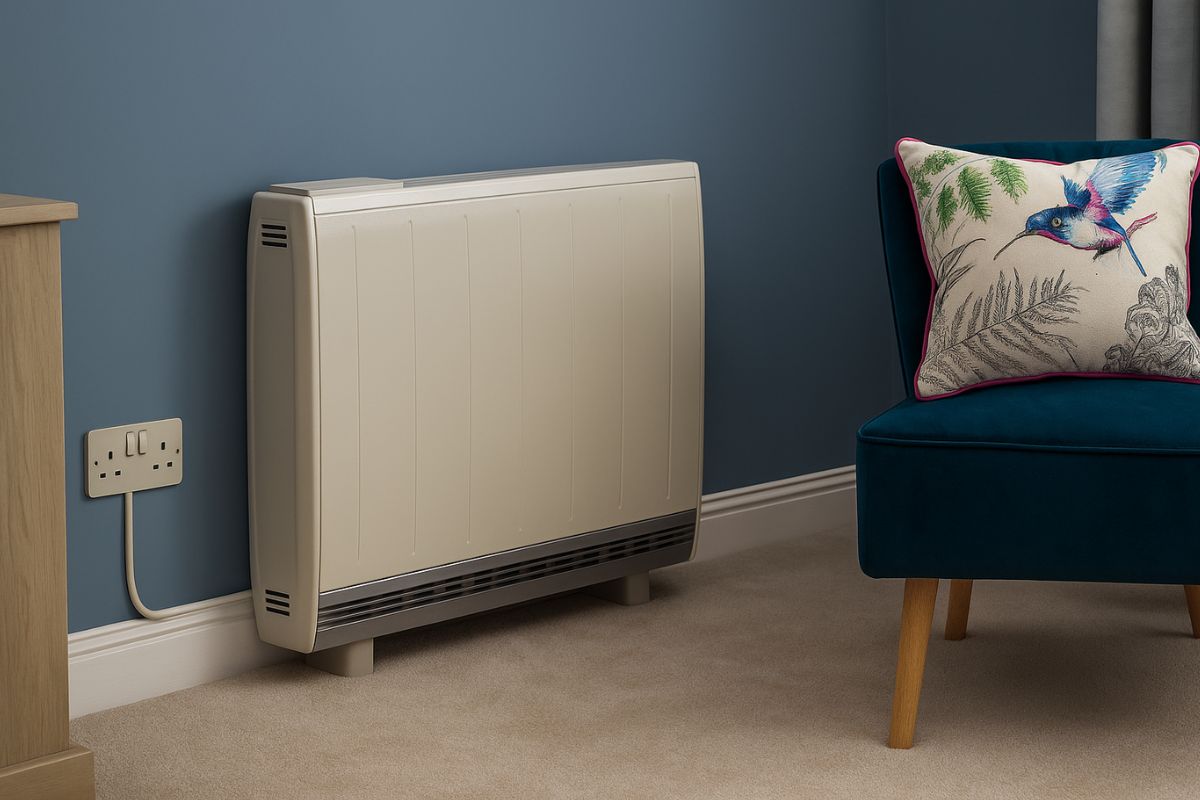
There were these chunky white boxes all along the walls in Gran’s house. They got hot overnight and stayed warm during the day. As a child, I believed it was magic. No, it was just physics, though the new ones are quite a brainy leap.
Some people ask me, ‘how do high heat retention storage heaters work?’ And to be honest, I think most of them want some kind of complicated answer. It’s not really. They charge when electricity is cheap, lock up the heat in special bricks, and release that heat when you want it. Simple as that. The details are where it starts to get fiddly, though.
Charging When It’s Cheap
Many people pay the same for electric whether they turn on their lights at 3 p.m. or 3 a.m. But Economy 7 tariffs offer you cheaper prices at night. Midnight to 7am, generally speaking, hence the name. Not rocket science.
Storage heaters consume the cheap nighttime juice and turn it into heat. That heat transfers to ceramic bricks inside the unit. These are not the normal house bricks but they are specially made to get really hot and stay that way for hours.
Gran’s old heaters leaked heat like a sieve. By noon, half the warmth had already escaped into the room. Didn’t matter if you wanted it or not. The new ones? Completely different story.
Keeping The Heat In
Modern heaters envelop those hot bricks in layer upon layer of serious insulation. Some of the best high heat retention storage heaters use aerogel. That’s space-age stuff. NASA uses it. It’s really good at keeping the heat in.
Dimplex high heat retention storage heaters incorporate their Quantum range with such aerogel insulation. The bricks themselves have also been redesigned. Different shapes, different materials, all designed to hold heat longer without letting it escape.
My cousin got one installed last winter. Says it’s like comparing a flask to a paper cup. Her old heater was warm in the morning, lukewarm by teatime. The new one stays hot all day.
Getting The Heat Out When You Want It
This is where old and new heaters part ways. The old ones had a dial. You could slow the heat down a bit, but it was coming out regardless. Perfect if you spend all day at home watching telly. Rubbish if you’re working until six.
New models have proper controls. Some have fans built in. These blow the trapped heat into your room when you want it, not whenever the heater feels like turning on. The fans are quieter now too. Gran’s vintage heaters hummed like a hairdryer when they turned on.
You can programme them. More heat when you are home in the morning and at night. Less when the place is empty during the day. You will be saving money because you’re not heating an empty house.
What’s Actually Inside These Things
So how do high heat retention storage heaters actually keep that heat within themselves? The bricks are high-density ceramic. They get absolutely scorching overnight. We’re talking hundreds of degrees. So then, the insulation around stops that heat from escaping.
It’s a thermos on steroids, except it’s filled with hot bricks, not tea. Whenever you need heat, a fan comes on or the vents open. The stored heat dissipates gradually. You’re in control, not the heater.
Getting Them Fitted
High heat retention storage heaters installation requires a correct electrician. Do not attempt this on your own unless you are in the mood to burn your house down. They also have to be wired into the off-peak circuit if you’re on Economy 7. Getting it wrong can prove very costly.
The vast majority of modern models hang on the wall. Saves floor space, especially in smaller spaces. The bricks are separate because they weigh a tonne. Literally. If you can avoid it, you don’t want to haul them up a pair of flights.
A good installer will rip out your old heaters, fit the new ones, wire them up properly and show you how to use the controls too. Requires a few hours per heater based on your home. My mate paid about £200 for installation on top of the heater cost.
What’s Available In The UK
The high heat retention storage heaters in the UK market has a few big names. Dimplex Quantum gets mentioned constantly. Fischer’s ElektroStore line is also well received. Both say you’ll save 27% compared to old storage heaters. Whether you actually do depends on how you use them.
Screwfix has a range of different models but it’s up to you to fit them. Plus, in some instances, the savings from buying direct don’t end up being savings at all once you’ve paid the electrician to come install your fancy new fixture. It’s worth calculating how much the all-in cost is, not just the heater price.
I’ve seen threads on Reddit where people rave about the Dimplex Quantum. The main complaint seems to be the price. They’re not cheap. A few hundred quid minimum per heater. More if you’ve got a big room.
The Tariff Problem
These heaters only save you money if you’re on Economy 7 or Economy 10 tariffs. Standard tariff? You are paying the same rate night and day so there’s no advantage.
But Economy 7 isn’t as good a deal as it seems. The daytime rate is usually higher to make up for the cheap night rate. So if you’re running your washing machine, dishwasher and oven during the daytime, then you could actually find yourself paying more overall.
Need to work out your actual usage before switching. How much electric do you use during the day? At night? Will cheaper heating offset more expensive everything else? Get a calculator out and do the sums properly.
Do They Actually Do What They Promise
Yeah, mostly. The new ones actually work — unlike the old dinosaurs. My cousin I mentioned earlier? Her bills dropped about 18%. Not even the 27% Dimplex claims but it’s not bad.
But you have to use them properly. It’s daft to be charging them every night when it is mild outside. Most have weather controls, or you can set the charge yourself. It takes a week or two to figure it out, but it’s not that difficult.
They’re not instant heat. If you arrive in a cold house and want to be warm right away, storage heaters just won’t work. They’re slow and steady. But for maintaining a place at a constant temperature throughout the day without immense bills? They’re pretty good.
Is It Worth It For You
So, when asking how do high heat retention storage heaters work, it comes down to overnight charging, good insulation, and controlled release. The modern ones are tremendous improvements over the old in energy and how you can use them.
Whether you should get them depends entirely on your situation. Already on Economy 7? Home during the day? Need steady heating rather than quick blasts? Then yeah, it’s probably worth looking at.
Still on a standard tariff? Out at work all day? The upfront cost is steep and you might not see the savings. My neighbour got them fitted and wishes he’d stuck with his old system because he’s never home to benefit from them.
Work out what you actually need before spending hundreds of quid on new heaters. They’re good at what they do, but what they do might not be what you need.