Look, I’ll be the first to admit that writing about “profit” while news of airstrikes fills the feed feels a bit grim. But if you’ve spent any time tracking how global markets react to chaos, you know that money doesn’t just vanish when the missiles fly. It migrates. Since “Operation Epic Fury” kicked off on 28 February 2026, the global economy has undergone a massive, violent reshuffle.
While most of us are staring at $110-a-barrel oil prices and wondering if we can afford the commute, a specific group of industries is having a record-breaking March. It’s not just about selling bullets; it’s about “scarcity arbitrage.” When the Strait of Hormuz gets choked off, whoever controls the remaining supply or the means to protect it basically wins the lottery.
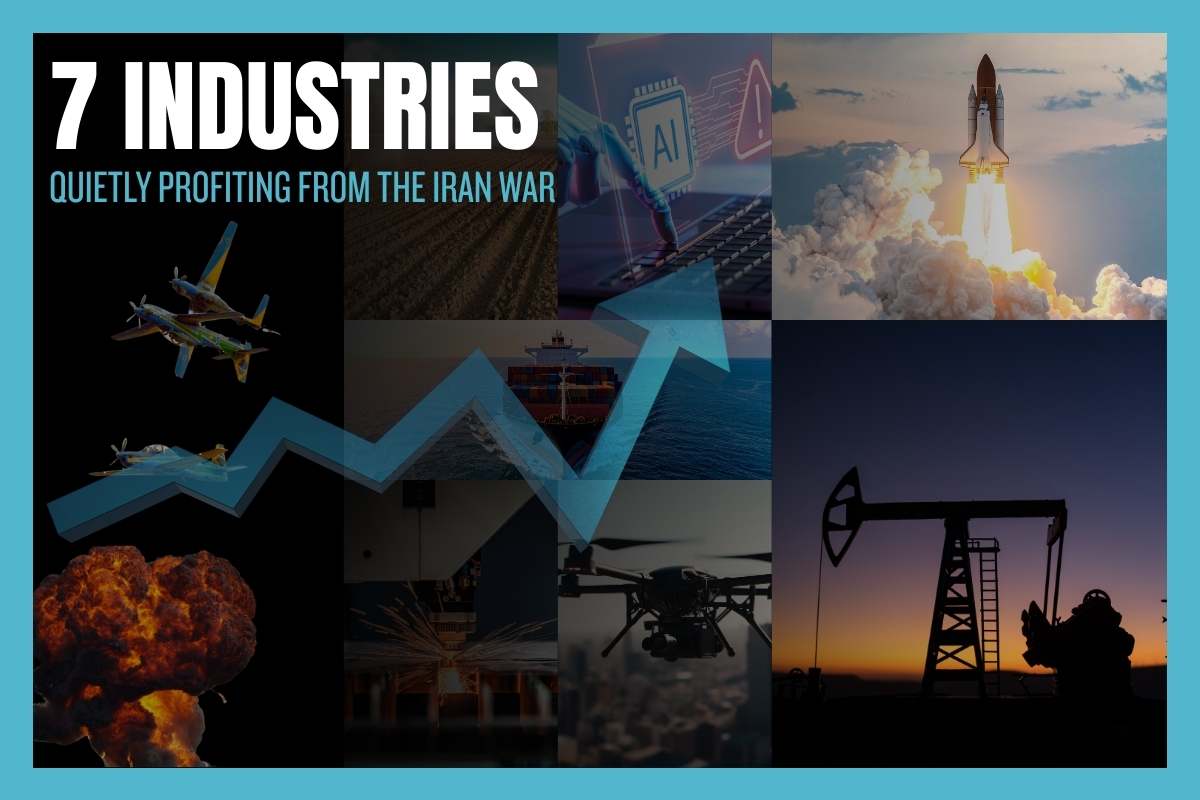
Here is the breakdown of the seven sectors currently raking it in while the world holds its breath.
1. The Arms Giants (Defence & Aerospace)
This is the one everyone knows, but the scale right now is honestly terrifying. We aren’t just talking about a few extra orders. The top US and Israeli defence firms are sitting on a combined backlog that’s north of $500 billion.
But here’s the thing: it’s not just about the big $100 million jets anymore. The real profit is in “attrition.” As reported by Al Jazeera’s latest tracking of military profit, companies like RTX and Lockheed Martin are “quadrupling production” of munitions. Why? Because we’re using them faster than we can make them. It’s a recurring revenue model that would make a Silicon Valley CEO weep with envy.
Also read: What the Strait of Hormuz Crisis Means for the UK Economy and Global Oil Prices in 2026
2. The Drone Upstarts (Expendable Warfare)
War in 2026 is a numbers game. We’ve moved away from risking pilots and toward “attritable” drones—basically, high-tech flying bombs that are meant to be lost. Companies like SpektreWorks and AeroVironment are seeing their margins explode because they’re selling $35,000 units by the thousands. It’s the “disposable” nature of this conflict that is driving the profit. If a $30,000 drone can take out a $2 million tank, the demand is never going to end.
3. The “Crack Spread” Kings (Oil Refiners)
Everyone blames the oil drillers when prices spike, but the refiners are the ones really laughing. There’s this thing called the “crack spread”—the difference between the cost of crude and the price of the petrol that comes out the other end.
With 20% of the world’s oil “frozen” behind the blockade, fuel is scarce. Complex refineries in the US Gulf Coast and Singapore are currently seeing margins of $30 per barrel. That’s the highest in years. They aren’t just selling oil; they’re selling the availability of fuel in a world that’s running dry.
Also read: Market Shift: Decoding the Tesla UK Sales Slump
4. The Digital Guards (Cybersecurity & AI)
Iran’s go-to move is asymmetric warfare—cyberattacks. Every bank, power grid, and hospital in the West is currently terrified of being hit. This has led to an absolute gold rush for firms like Palantir and specialised AI-cyber outfits. Governments are signing “mission-critical” data contracts that are basically blank cheques. They’re being paid to watch the digital borders, and business has never been better.
5. The “War Risk” Tax (Maritime Insurance)
Maritime insurers have essentially become the tax collectors of the high seas. If you want to move cargo anywhere near the Middle East, you’re paying a “conflict surcharge.” These premiums have multiplied by 1,200%.
The logic is simple: most ships won’t get hit, but every ship has to pay. It’s a massive pooling of cash that builds up a huge war chest for the insurers. As long as the risk is perceived as high, the money keeps rolling in.
Also read: Why the Sheffield Wednesday Takeover Saga Could Take a Huge Twist in May
6. The Scarcity Traders (Rare Earths & Industrial Metals)
The Middle East is a huge hub for aluminium and cement. With the shipping lanes jammed, the supply has fallen off a cliff. Trading houses that had stockpiles sitting in warehouses in Europe or Asia are now selling at “crisis prices”. They’re not producing anything new; they’re just charging a premium for what they already have. It’s the ultimate middleman win.
7. The Food Security Players (Agricultural Commodities)
This is the seventh one—and it’s the most subtle. The Middle East is a massive producer of ammonia and nitrogen, the key ingredients in fertiliser. As the war disrupts these plants and their shipping routes, fertiliser prices are going through the roof.
The companies that produce these chemicals outside the conflict zone—like those in Norway or Canada—are seeing their valuations soar. It’s a domino effect: high fertiliser prices lead to higher food prices globally. Every time you pay more for a loaf of bread, you’re feeling the “quiet profit” of the agricultural commodity giants who are capitalising on the supply shock.
The Hidden Supply Chain Ripple
The messy reality of this conflict is that the damage doesn’t stay in the Middle East. It bleeds into things that have absolutely nothing to do with geopolitics. I was chatting with a mate in the digital signage and tech hardware space last week, and he’s tearing his hair out. Hardware costs have jumped by a solid 20% almost overnight. Why? Because the tiny, critical components that usually breeze through the Gulf are now stuck in a logistical nightmare.
It’s what experts call a “mosaic” of pain. While the average person gets stung at the till, the gatekeepers of these alternative routes are making a killing. According to the latest Baker Donelson report on global supply chain shocks, we’re seeing a total collapse in “Asia-to-Europe” transit times, forcing companies to pay “scarcity ransoms” just to keep their assembly lines moving. Honestly, it’s a shambles, and we’re the ones picking up the tab for it in the end.
Also read: Getting Into Estate Agency – What It Actually Takes in 2025
Who is Actually Losing?
Not everyone gets sunshine and rainbows. Far from it. The losers are clear if you know where to look:
- Aviation and Tourism: Airlines like Emirates and Etihad stand to lose billions. Dubai, typically a sparkling centre of activity, is experiencing relative paralysis as the flight paths get rerouted or grounded.
- The High Street: Retailers are being hit from both sides. Freight is more expensive, and consumer confidence is in the bin. People don’t want to buy a new sofa when they are fretting about the cost of bread.
- The Car Industry: Fuel prices remain high, and a new bout of semiconductor delays (thanks to collapses in logistics) is threatening to wipe out any 2026 growth forecasts.
FAQ
Is the Iran War causing global inflation to rise?
Yes. Early estimates predict a direct energy and freight inflation increase of around 0.8% globally. If the blockade lasts through the summer, that number could double.
Which specific companies are seeing the biggest stock jumps?
Lockheed Martin, RTX, and Northrop Grumman are the big three. In the tech space, Palantir and cybersecurity firms have seen the most aggressive “wartime” growth.
Why are insurance premiums so high?
Insurers use “War Risk” clauses. When a region is declared a conflict zone, it can legally increase premiums by massive amounts to cover the potential total loss of a vessel.
Will fuel prices come down soon?
Unlikely as long as the Strait of Hormuz remains a “frozen” zone. Even if the fighting stops tomorrow, the backlog in shipping and the “risk premium” baked into oil prices will take months to settle.
The Bottom Line
The 2026 Iran War is a brutal reminder that modern conflict is an economic engine. It’s a regime change for your bank account. Wealth is being drained from the general public and funnelled into these seven industrial “tiles”. It’s efficient, it’s cold, and it’s happening every time you tap your card at the pump.
Anyway, it’s a bit of a grim reality check, isn’t it? The question is, how long can the global economy stay afloat before these “quiet profits” turn into a loud, systemic crash?
Sources & References
- Al Jazeera News: Which US and Israeli military companies are profiting from the Iran war? (9 March 2026). A deep dive into the “quadrupled production” agreements at the White House. Full Industry Analysis.
- Baker Donelson: The 2026 Iran War and Its Global Impact on Construction Supply Chains. (March 2026). This is the “gold standard” for understanding why steel, cement, and aluminium prices are currently in the stratosphere. View the Full Report.
- IRU (World Road Transport Organisation): War in Iran: Fuel prices remain high and volatile. (13 March 2026). The definitive source for current Brent Crude tracking ($100–$120/bbl) and pump price spikes across the UK and EU. Live Fuel Tracker.
- Modern Diplomacy: How Maritime Insurance Rates Reflect a Widening Middle East War. (6 March 2026). Breaking down that 1,000% spike in war-risk premiums for tankers. Maritime Risk Coverage.
- U.S. Department of War: Operation Epic Fury Official Spotlight. (March 2026). For verified military objectives and the status of the blockade. Official White House Updates.
- Britannica: 2026 Iran Conflict | Explained. A comprehensive timeline of the 28 February outbreak and the following 12-day escalation. Historical Timeline.